Yoshiki Masuyama
- Phone: 617-621-7552
- Email:
-
Position:
Research / Technical Staff
Visiting Research Scientist -
Education:
Ph.D., Tokyo Metropolitan University, 2024 -
Research Areas:
External Links:
Yoshiki's Quick Links
-
Biography
Yoshiki's research interests focus on the integration of signal processing and machine learning technologies for efficient and robust audio processing. He has worked on a wide range of audio signal processing tasks, especially multichannel speech separation, robust automatic speech recognition, and multimodal learning. He is the recipient of the Best Student Paper Award at the IEEE Spoken Language Technology Workshop 2022.
-
Recent News & Events
-
EVENT MERL Contributes to ICASSP 2026 Date: Monday, May 4, 2026 - , May 8, 2026
Location: Barcelona, Spain
MERL Contacts: Wael H. Ali; Petros T. Boufounos; Chiori Hori; Jonathan Le Roux; Yanting Ma; Hassan Mansour; Yoshiki Masuyama; Joshua Rapp; Anthony Vetro; Pu (Perry) Wang; Gordon Wichern
Research Areas: Artificial Intelligence, Computational Sensing, Computer Vision, Machine Learning, Optimization, Signal Processing, Speech & AudioBrief- MERL has made numerous contributions to both the organization and technical program of ICASSP 2026, which is being held in Barcelona, Spain from May 4-8, 2026.
Sponsorship
MERL is proud to be a Silver Patron of the conference and will participate in the student job fair on Thursday, May 7. Please join this session to learn more about employment opportunities at MERL, including openings for research scientists, post-docs, and interns. MERL Distinguished Research Scientists Petros T. Boufounos and Jonathan Le Roux will also present a spotlight session on MERL’s research in signal processing on Tuesday, May 5 at 13:05. Finally, MERL will sponsor a photo booth on Thursday, May 7 and Friday, May 8, where ICASSP participants can take professional photos with friends and colleagues, which will be emailed to them.
MERL is also pleased to be the sponsor of two IEEE Awards that will be presented at the conference. We congratulate Prof. Nasir Ahmed, the recipient of the 2026 IEEE Fourier Award for Signal Processing, and Dr. Alex Acero, the recipient of the 2026 IEEE James L. Flanagan Speech and Audio Processing Award.
Technical Program
MERL is presenting 8 papers in the main conference on a wide range of topics including source separation, spatial audio, neural audio codecs, radar-based pose estimation, camera-based airflow sensing, radar array processing, and optimization. Another paper on neural speech codecs will be presented at the Low-Resource Audio Codec (LRAC) Satellite Workshop. MERL researchers will also present two articles published in IEEE Open Journal of Signal Processing (OJSP) on music source separation and head-related transfer function (HRTF) modeling. Finally, Speech and Audio Team members Yoshiki Masuyama and Jonathan Le Roux co-organized a Special Session on Neural Spatial Audio Processing, which will feature six oral presentations.
About ICASSP
ICASSP is the flagship conference of the IEEE Signal Processing Society, and the world's largest and most comprehensive technical conference focused on the research advances and latest technological development in signal and information processing. The event attracts more than 4000 participants each year.
- MERL has made numerous contributions to both the organization and technical program of ICASSP 2026, which is being held in Barcelona, Spain from May 4-8, 2026.
-
EVENT SANE 2025 - Speech and Audio in the Northeast Date: Friday, November 7, 2025
Location: Google, New York, NY
MERL Contacts: Jonathan Le Roux; Yoshiki Masuyama
Research Areas: Artificial Intelligence, Machine Learning, Speech & AudioBrief- SANE 2025, a one-day event gathering researchers and students in speech and audio from the Northeast of the American continent, was held on Friday November 7, 2025 at Google, in New York, NY.
It was the 12th edition in the SANE series of workshops, which started in 2012 and is typically held every year alternately in Boston and New York. Since the first edition, the audience has grown to about 200 participants and 50 posters each year, and SANE has established itself as a vibrant, must-attend event for the speech and audio community across the northeast and beyond.
SANE 2025 featured invited talks by six leading researchers from the Northeast as well as from the wider community: Dan Ellis (Google Deepmind), Leibny Paola Garcia Perera (Johns Hopkins University), Yuki Mitsufuji (Sony AI), Julia Hirschberg (Columbia University), Yoshiki Masuyama (MERL), and Robin Scheibler (Google Deepmind). It also featured a lively poster session with 50 posters.
MERL Speech and Audio Team's Yoshiki Masuyama presented a well-received overview of the team's recent work on "Neural Fields for Spatial Audio Modeling". His talk highlighted how neural fields are reshaping spatial audio research by enabling flexible, data-driven interpolation of head-related transfer functions and room impulse responses. He also discussed the integration of sound-propagation physics into neural field models through physics-informed neural networks, showcasing MERL’s advances at the intersection of acoustics and deep learning.
SANE 2025 was co-organized by Jonathan Le Roux (MERL), Quan Wang (Google Deepmind), and John R. Hershey (Google Deepmind). SANE remained a free event thanks to generous sponsorship by Google, MERL, Apple, Bose, and Carnegie Mellon University.
Slides and videos of the talks are available from the SANE workshop website and via a YouTube playlist.
- SANE 2025, a one-day event gathering researchers and students in speech and audio from the Northeast of the American continent, was held on Friday November 7, 2025 at Google, in New York, NY.
See All News & Events for Yoshiki -
-
Awards
-
AWARD MERL Team Wins Real-TSE Challenge Track 2 on Offline Target Speaker Extraction Date: July 6, 2026
Awarded to: Dominik Klement, Yoshiki Masuyama, Christoph Boeddeker, Kohei Saijo, Julius Richter, Gordon Wichern, and Jonathan Le Roux
MERL Contacts: Christoph Boeddeker; Jonathan Le Roux; Yoshiki Masuyama; Julius Richter; Gordon Wichern
Research Areas: Artificial Intelligence, Machine Learning, Speech & AudioBriefMERL's Speech & Audio team, led by MERL intern Dominik Klement, ranked 1st out of 11 teams in Track 2, "Offline Target Speaker Extraction," of the Real-TSE Challenge. The challenge focuses on target speaker extraction (TSE) from real-world conversational recordings in either English or Chinese, where the goal is to extract the speech of a target speaker in the presence of interfering speakers, background noise, and reverberation.
While modern TSE systems have achieved strong performance on simulated speech mixtures, their performance can degrade considerably on real-world recordings due to the mismatch between simulated training data and actual conversational environments. The Real-TSE Challenge was designed to advance TSE under these realistic conditions, using real far-field conversational recordings for evaluation.
The MERL team won Track 2 by focusing on training data and curriculum learning rather than introducing a new model architecture. Starting from a strong speech separation model, the team progressively trained the system on fully overlapping synthetic speech, simulated conversations, realistic far-field mixtures, and finally real conversational recordings. This approach reduced the token error rate (TER), measured at either the word (English) or character (Chinese) level, from 70% to 37% on the development set and achieved a final TER of 61.3% on the evaluation set, best among the 11 participating teams. The team also topped the leaderboard in terms of the aggregate ranking across the four measures evaluating intelligibility, target speaker presence rate, speaker similarity, and perceptual quality.
The team also investigated the reliability of the challenge metrics and demonstrated that neural network-based speaker similarity and predicted speech-quality scores could be substantially improved without a corresponding improvement in perceptual quality. Because learned metrics can be susceptible to adversarial attacks or optimization that exploits weaknesses in the metric itself, these findings highlight both the importance of realistic training data for real-world TSE and the need for robust evaluation metrics when developing speech extraction systems.
A paper summarizing the team's findings will be presented at the IEEE Spoken Language Technology (SLT) 2026 workshop, to be held in Palermo, Italy from December 13-16, 2026.
REAL-TSE Challenge: Track 2 rankings — Offline Target Speaker Extraction Rank Team TER ↓ F1 ↑ SIM ↑ P808 ↑ Score ↓ 1 MERL 0.613 (1) 0.861 (2) 0.538 (3) 3.371 (2) 2.00 2 YiJiaHe 0.639 (2) 0.871 (1) 0.565 (1) 3.128 (9) 3.25 3 CARTSE 0.651 (3) 0.857 (4) 0.544 (2) 3.138 (8) 4.25 4 WasedaM 0.675 (5) 0.858 (3) 0.480 (6) 3.232 (6) 5.00 5 SonicAGI 0.680 (6) 0.851 (6) 0.471 (7) 3.258 (5) 6.00 6 WAKA 0.670 (4) 0.847 (8) 0.471 (7) 3.150 (7) 6.50 6 SHNU-TSE 0.731 (9) 0.840 (9) 0.507 (5) 3.362 (3) 6.50 7 ChuEst 0.710 (7) 0.831 (11) 0.532 (4) 3.064 (10) 8.00 8 pyannoteAI 0.728 (8) 0.855 (5) 0.464 (9) 2.904 (12) 8.50 9 AGH-JHU 0.743 (10) 0.837 (10) 0.434 (11) 3.335 (4) 8.75 10 WHU_IASP 0.757 (11) 0.850 (7) 0.465 (8) 2.961 (11) 9.25 11 CUDA_OUT_OF_MEMORY 0.827 (12) 0.819 (13) 0.364 (13) 3.435 (1) 9.75 12 BSRNN_EMB Baseline 0.829 (13) 0.829 (12) 0.417 (12) 2.875 (13) 12.50 12 BSRNN_TFMAP Baseline 0.838 (14) 0.829 (12) 0.443 (10) 2.756 (14) 12.50 ↓ Lower is better; ↑ higher is better. Parentheses show metric ranks. The score is the average of the four dense metric ranks; tied scores share a position. Best metric values are bold. P808 denotes DNSMOS-P808.
Source: Official REAL-TSE Challenge rankings. BSRNN entries are organizer baselines.
-
AWARD MERL Team Wins DCASE 2026 Challenge on Anomalous Sound Detection for Machine Condition Monitoring Date: June 30, 2026
Awarded to: Takuya Fujimura, Gordon Wichern, Yoshiki Masuyama, Christoph Boeddeker, Kohei Saijo, Julius Richter, Takahiro Edo, and Jonathan Le Roux
MERL Contacts: Christoph Boeddeker; Jonathan Le Roux; Yoshiki Masuyama; Julius Richter; Gordon Wichern
Research Areas: Artificial Intelligence, Machine Learning, Signal Processing, Speech & AudioBrief- MERL's Speech & Audio team ranked 1st out of 51 teams in the DCASE 2026 Challenge’s Task 2, “Noise-aware Unsupervised Anomalous Sound Detection for Machine Condition Monitoring.” The team was led by MERL intern Takuya Fujimura, and also included Gordon Wichern, Yoshiki Masuyama, Christoph Boeddeker, Kohei Saijo, Julius Richter, Takahiro Edo, and Jonathan Le Roux.
The IEEE AASP Challenge on Detection and Classification of Acoustic Scenes and Events (DCASE Challenge), started in 2013, has been organized yearly since 2016, and gathers challenges on multiple tasks related to the detection, analysis, and generation of sound events. This year, the DCASE 2026 Challenge received 421 submissions from 135 teams across seven tasks.
The MERL team won Task 2, Noise-aware Unsupervised Anomalous Sound Detection for Machine Condition Monitoring, which aims at building noise-robust systems for automatically detecting machine failure via microphones when only normal machine operating data is available for system development. Task 2 was by far the most popular out of the 7 DCASE 2026 tasks, with 51 teams submitting 168 entries. The MERL team's system was built around MERL’s recently proposed paradigm of noise-aware self-supervised learning, which extracts noise robust features leveraging two-channel recordings, in which one microphone is used to capture noise. Anomaly detection is then performed in the extracted denoised feature space using advanced score normalization. The team's best submission obtained a composite score of 70.24% on five evaluation machines, largely outperforming the 2nd best team's 65.45%.
MERL also participated in Task 4, Spatial Semantic Segmentation of Sound Scenes (S5) and placed 3rd out of 10 teams in separation performance. Our cascaded system consists of universal sound separation with source counting, source classification, and class-aware refinement, where the separation and refinement modules are built upon MERL's TF-Locoformer separation technology. Notably, the team's best submission obtained a label prediction accuracy of 76.92% on the evaluation set, largely outperforming the 2nd best team's 65.54%.
- MERL's Speech & Audio team ranked 1st out of 51 teams in the DCASE 2026 Challenge’s Task 2, “Noise-aware Unsupervised Anomalous Sound Detection for Machine Condition Monitoring.” The team was led by MERL intern Takuya Fujimura, and also included Gordon Wichern, Yoshiki Masuyama, Christoph Boeddeker, Kohei Saijo, Julius Richter, Takahiro Edo, and Jonathan Le Roux.
-
AWARD MERL team wins the Generative Data Augmentation of Room Acoustics (GenDARA) 2025 Challenge Date: April 7, 2025
Awarded to: Christopher Ick, Gordon Wichern, Yoshiki Masuyama, François G. Germain, and Jonathan Le Roux
MERL Contacts: Jonathan Le Roux; Yoshiki Masuyama; Gordon Wichern
Research Areas: Artificial Intelligence, Machine Learning, Speech & AudioBrief- MERL's Speech & Audio team ranked 1st out of 3 teams in the Generative Data Augmentation of Room Acoustics (GenDARA) 2025 Challenge, which focused on “generating room impulse responses (RIRs) to supplement a small set of measured examples and using the augmented data to train speaker distance estimation (SDE) models". The team was led by MERL intern Christopher Ick, and also included Gordon Wichern, Yoshiki Masuyama, François G. Germain, and Jonathan Le Roux.
The GenDARA Challenge was organized as part of the Generative Data Augmentation (GenDA) workshop at the 2025 IEEE International Conference on Acoustics, Speech, and Signal Processing (ICASSP 2025), and held on April 7, 2025 in Hyderabad, India. Yoshiki Masuyama presented the team's method, "Data Augmentation Using Neural Acoustic Fields With Retrieval-Augmented Pre-training".
The GenDARA challenge aims to promote the use of generative AI to synthesize RIRs from limited room data, as collecting or simulating RIR datasets at scale remains a significant challenge due to high costs and trade-offs between accuracy and computational efficiency. The challenge asked participants to first develop RIR generation systems capable of expanding a sparse set of labeled room impulse responses by generating RIRs at new source–receiver positions. They were then tasked with using this augmented dataset to train speaker distance estimation systems. Ranking was determined by the overall performance on the downstream SDE task. MERL’s approach to the GenDARA challenge centered on a geometry-aware neural acoustic field model that was first pre-trained on a large external RIR dataset to learn generalizable mappings from 3D room geometry to room impulse responses. For each challenge room, the model was then adapted or fine-tuned using the small number of provided RIRs, enabling high-fidelity generation of RIRs at unseen source–receiver locations. These augmented RIR sets were subsequently used to train the SDE system, improving speaker distance estimation by providing richer and more diverse acoustic training data.
- MERL's Speech & Audio team ranked 1st out of 3 teams in the Generative Data Augmentation of Room Acoustics (GenDARA) 2025 Challenge, which focused on “generating room impulse responses (RIRs) to supplement a small set of measured examples and using the augmented data to train speaker distance estimation (SDE) models". The team was led by MERL intern Christopher Ick, and also included Gordon Wichern, Yoshiki Masuyama, François G. Germain, and Jonathan Le Roux.
-
AWARD MERL team wins the Listener Acoustic Personalisation (LAP) 2024 Challenge Date: August 29, 2024
Awarded to: Yoshiki Masuyama, Gordon Wichern, Francois G. Germain, Christopher Ick, and Jonathan Le Roux
MERL Contacts: Jonathan Le Roux; Gordon Wichern; Yoshiki Masuyama
Research Areas: Artificial Intelligence, Machine Learning, Speech & AudioBrief- MERL's Speech & Audio team ranked 1st out of 7 teams in Task 2 of the 1st SONICOM Listener Acoustic Personalisation (LAP) Challenge, which focused on "Spatial upsampling for obtaining a high-spatial-resolution HRTF from a very low number of directions". The team was led by Yoshiki Masuyama, and also included Gordon Wichern, Francois Germain, MERL intern Christopher Ick, and Jonathan Le Roux.
The LAP Challenge workshop and award ceremony was hosted by the 32nd European Signal Processing Conference (EUSIPCO 24) on August 29, 2024 in Lyon, France. Yoshiki Masuyama presented the team's method, "Retrieval-Augmented Neural Field for HRTF Upsampling and Personalization", and received the award from Prof. Michele Geronazzo (University of Padova, IT, and Imperial College London, UK), Chair of the Challenge's Organizing Committee.
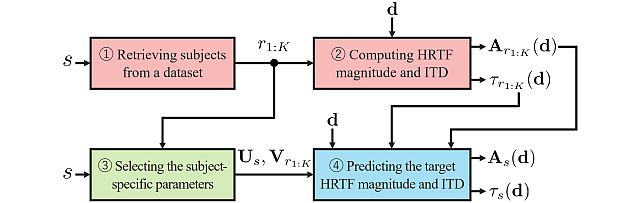
The LAP challenge aims to explore challenges in the field of personalized spatial audio, with the first edition focusing on the spatial upsampling and interpolation of head-related transfer functions (HRTFs). HRTFs with dense spatial grids are required for immersive audio experiences, but their recording is time-consuming. Although HRTF spatial upsampling has recently shown remarkable progress with approaches involving neural fields, HRTF estimation accuracy remains limited when upsampling from only a few measured directions, e.g., 3 or 5 measurements. The MERL team tackled this problem by proposing a retrieval-augmented neural field (RANF). RANF retrieves a subject whose HRTFs are close to those of the target subject at the measured directions from a library of subjects. The HRTF of the retrieved subject at the target direction is fed into the neural field in addition to the desired sound source direction. The team also developed a neural network architecture that can handle an arbitrary number of retrieved subjects, inspired by a multi-channel processing technique called transform-average-concatenate.
- MERL's Speech & Audio team ranked 1st out of 7 teams in Task 2 of the 1st SONICOM Listener Acoustic Personalisation (LAP) Challenge, which focused on "Spatial upsampling for obtaining a high-spatial-resolution HRTF from a very low number of directions". The team was led by Yoshiki Masuyama, and also included Gordon Wichern, Francois Germain, MERL intern Christopher Ick, and Jonathan Le Roux.
-
AWARD MERL team wins the Audio-Visual Speech Enhancement (AVSE) 2023 Challenge Date: December 16, 2023
Awarded to: Zexu Pan, Gordon Wichern, Yoshiki Masuyama, Francois Germain, Sameer Khurana, Chiori Hori, and Jonathan Le Roux
MERL Contacts: Chiori Hori; Jonathan Le Roux; Gordon Wichern; Yoshiki Masuyama
Research Areas: Artificial Intelligence, Machine Learning, Speech & AudioBrief- MERL's Speech & Audio team ranked 1st out of 12 teams in the 2nd COG-MHEAR Audio-Visual Speech Enhancement Challenge (AVSE). The team was led by Zexu Pan, and also included Gordon Wichern, Yoshiki Masuyama, Francois Germain, Sameer Khurana, Chiori Hori, and Jonathan Le Roux.
The AVSE challenge aims to design better speech enhancement systems by harnessing the visual aspects of speech (such as lip movements and gestures) in a manner similar to the brain’s multi-modal integration strategies. MERL’s system was a scenario-aware audio-visual TF-GridNet, that incorporates the face recording of a target speaker as a conditioning factor and also recognizes whether the predominant interference signal is speech or background noise. In addition to outperforming all competing systems in terms of objective metrics by a wide margin, in a listening test, MERL’s model achieved the best overall word intelligibility score of 84.54%, compared to 57.56% for the baseline and 80.41% for the next best team. The Fisher’s least significant difference (LSD) was 2.14%, indicating that our model offered statistically significant speech intelligibility improvements compared to all other systems.
- MERL's Speech & Audio team ranked 1st out of 12 teams in the 2nd COG-MHEAR Audio-Visual Speech Enhancement Challenge (AVSE). The team was led by Zexu Pan, and also included Gordon Wichern, Yoshiki Masuyama, Francois Germain, Sameer Khurana, Chiori Hori, and Jonathan Le Roux.
-
-
Research Highlights
-
MERL Publications
- , "Evaluating Inference-time Algorithms for Semantic Sound Scene Segmentation", arXiv, October 2026.BibTeX arXiv
- @article{Sridhar2026oct,
- author = {Sridhar, Sripathi and Wichern, Gordon and Masuyama, Yoshiki and Cartwright, Mark and {Le Roux}, Jonathan},
- title = {{Evaluating Inference-time Algorithms for Semantic Sound Scene Segmentation}},
- journal = {arXiv},
- year = 2026,
- month = oct,
- url = {https://arxiv.org/abs/2610.03602}
- }
- , "Speaker Identity as Sole Supervision for Speech Separation", Interspeech, September 2026.BibTeX TR2026-137 PDF
- @inproceedings{Boeddeker2026sep,
- author = {Boeddeker, Christoph and Masuyama, Yoshiki and Richter, Julius and Edo, Takahiro and Wichern, Gordon and {Le Roux}, Jonathan},
- title = {{Speaker Identity as Sole Supervision for Speech Separation}},
- booktitle = {Interspeech},
- year = 2026,
- month = sep,
- url = {https://www.merl.com/publications/TR2026-137}
- }
- , "Echoes after Edits: Room Impulse Response Estimation for Geometry Update", Interspeech, DOI: 10.21437/Interspeech.2026-2514, September 2026, pp. 2958-2962.BibTeX TR2026-140 PDF
- @inproceedings{Bhosale2026sep2,
- author = {Bhosale, Swapnil and Masuyama, Yoshiki and Chatterjee, Moitreya and Boeddeker, Christoph and Richter, Julius and Wichern, Gordon and {Le Roux}, Jonathan},
- title = {{Echoes after Edits: Room Impulse Response Estimation for Geometry Update}},
- booktitle = {Interspeech},
- year = 2026,
- pages = {2958--2962},
- month = sep,
- doi = {10.21437/Interspeech.2026-2514},
- issn = {2958-1796},
- url = {https://www.merl.com/publications/TR2026-140}
- }
- , "Plan and Double-Check: Streaming Multimodal Q-Former for Online Robot Action Generation", Interspeech, September 2026.BibTeX TR2026-136 PDF
- @inproceedings{Hori2026sep,
- author = {{Hori, Chiori and Korekata, Ryosuke and Kambara, Motonari and Masuyama, Yoshiki and Jain, Siddarth and Corcodel, Radu and Romeres, Diego and Le Roux, Jonathan}},
- title = {{Plan and Double-Check: Streaming Multimodal Q-Former for Online Robot Action Generation}},
- booktitle = {Interspeech},
- year = 2026,
- month = sep,
- url = {https://www.merl.com/publications/TR2026-136}
- }
- , "HRTF Personalization via Sim-to-Real Neural Field", Interspeech, DOI: 10.21437/Interspeech.2026-1391, September 2026, pp. 696-701.BibTeX TR2026-135 PDF Software
- @inproceedings{Masuyama2026sep2,
- author = {Masuyama, Yoshiki and Wichern, Gordon and Boeddeker, Christoph and Richter, Julius and Edo, Takahiro and Bhosale, Swapnil and {Le Roux}, Jonathan},
- title = {{HRTF Personalization via Sim-to-Real Neural Field}},
- booktitle = {Interspeech},
- year = 2026,
- pages = {696--701},
- month = sep,
- doi = {10.21437/Interspeech.2026-1391},
- issn = {2958-1796},
- url = {https://www.merl.com/publications/TR2026-135}
- }
- , "Evaluating Inference-time Algorithms for Semantic Sound Scene Segmentation", arXiv, October 2026.
-
Software & Data Downloads
-
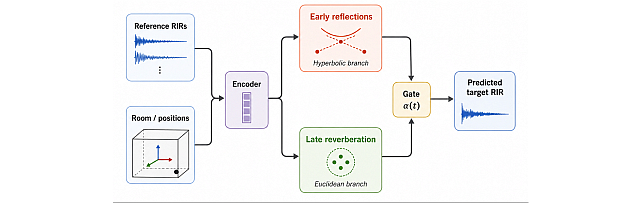
Dual-Geometry Manifolds for Few-shot RIR Prediction -

Sim-to-Real Neural Field -
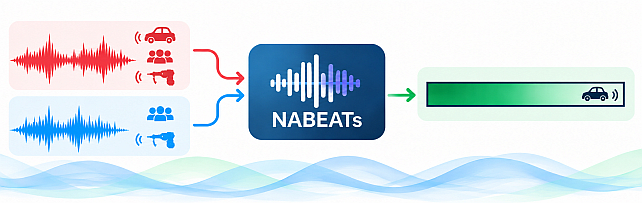
Noise-Aware Audio Representation Learning -
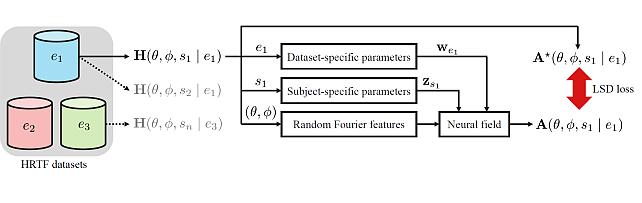
Subject- and Dataset-Aware Neural Field for HRTF Modeling -
Retrieval-Augmented Neural Field for HRTF Upsampling and Personalization -
Stochastic Interpolants for Speech Enhancement and Separation
-