TR2026-009
SuDaField: Subject- and Dataset-Aware Neural Field for HRTF Modeling
-
- , "SuDaField: Subject- and Dataset-Aware Neural Field for HRTF Modeling", IEEE Open Journal of Signal Processing, DOI: 10.1109/OJSP.2025.3627073, Vol. 6, pp. 1169-1178, December 2025.BibTeX TR2026-009 PDF Software
- @article{Masuyama2025dec2,
- author = {Masuyama, Yoshiki and Wichern, Gordon and Germain, François G and Ick, Christopher and {Le Roux}, Jonathan},
- title = {{SuDaField: Subject- and Dataset-Aware Neural Field for HRTF Modeling}},
- journal = {IEEE Open Journal of Signal Processing},
- year = 2025,
- volume = 6,
- pages = {1169--1178},
- month = dec,
- doi = {10.1109/OJSP.2025.3627073},
- url = {https://www.merl.com/publications/TR2026-009}
- }
- , "SuDaField: Subject- and Dataset-Aware Neural Field for HRTF Modeling", IEEE Open Journal of Signal Processing, DOI: 10.1109/OJSP.2025.3627073, Vol. 6, pp. 1169-1178, December 2025.
-
MERL Contacts:
-
Research Areas:


Abstract:
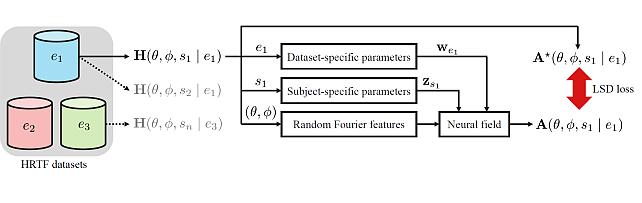
This paper presents SuDaField, a subject- and dataset-aware neural field (NF) that can leverage multiple head-related transfer function (HRTF) datasets. NF-based HRTF modeling has gained much attention because its grid-agnostic formulation accommodates any spatial grids during training and inference. While NFs are grid-agnostic, their training on multiple datasets remains challenging, as HRTFs from different datasets exhibit distinct characteristics due to variations in measurement setups. To mitigate this issue, Task 1 of the Listener Acoustic Personalization (LAP) Challenge 2024 proposed the task of HRTF harmonization, which aims to compensate for dataset-specific effects while preserving spatial cues of the original HRTFs. The harmonization itself is still hindered by the difference in spatial grids and the ill-defined nature of ideal harmonized HRTFs. We thus propose a well-defined framework of HRTF conversion and realize this by concurrently performing NF training and disentanglement of subject- and dataset-specific information. Our NF adopts dataset-specific parameters shared across all subjects within each dataset, with these parameters capturing the influence of the measurement setups. By replacing the dataset-specific parameters with those of another dataset, we can convert HRTFs recorded in one environment to what they would be if recorded in another environment. Our experimental results show that the dataset-specific parameters allow us to effectively perform HRTF conversion, achieving state-of- the-art performance on Task 1 of the LAP Challenge 2024.
Software & Data Downloads
Related News & Events
-
EVENT MERL Contributes to ICASSP 2026 Date: Monday, May 4, 2026 - , May 8, 2026
Location: Barcelona, Spain
MERL Contacts: Wael H. Ali; Petros T. Boufounos; Chiori Hori; Jonathan Le Roux; Yanting Ma; Hassan Mansour; Yoshiki Masuyama; Joshua Rapp; Anthony Vetro; Pu (Perry) Wang; Gordon Wichern
Research Areas: Artificial Intelligence, Computational Sensing, Computer Vision, Machine Learning, Optimization, Signal Processing, Speech & AudioBrief- MERL has made numerous contributions to both the organization and technical program of ICASSP 2026, which is being held in Barcelona, Spain from May 4-8, 2026.
Sponsorship
MERL is proud to be a Silver Patron of the conference and will participate in the student job fair on Thursday, May 7. Please join this session to learn more about employment opportunities at MERL, including openings for research scientists, post-docs, and interns. MERL Distinguished Research Scientists Petros T. Boufounos and Jonathan Le Roux will also present a spotlight session on MERL’s research in signal processing on Tuesday, May 5 at 13:05. Finally, MERL will sponsor a photo booth on Thursday, May 7 and Friday, May 8, where ICASSP participants can take professional photos with friends and colleagues, which will be emailed to them.
MERL is also pleased to be the sponsor of two IEEE Awards that will be presented at the conference. We congratulate Prof. Nasir Ahmed, the recipient of the 2026 IEEE Fourier Award for Signal Processing, and Dr. Alex Acero, the recipient of the 2026 IEEE James L. Flanagan Speech and Audio Processing Award.
Technical Program
MERL is presenting 8 papers in the main conference on a wide range of topics including source separation, spatial audio, neural audio codecs, radar-based pose estimation, camera-based airflow sensing, radar array processing, and optimization. Another paper on neural speech codecs will be presented at the Low-Resource Audio Codec (LRAC) Satellite Workshop. MERL researchers will also present two articles published in IEEE Open Journal of Signal Processing (OJSP) on music source separation and head-related transfer function (HRTF) modeling. Finally, Speech and Audio Team members Yoshiki Masuyama and Jonathan Le Roux co-organized a Special Session on Neural Spatial Audio Processing, which will feature six oral presentations.
About ICASSP
ICASSP is the flagship conference of the IEEE Signal Processing Society, and the world's largest and most comprehensive technical conference focused on the research advances and latest technological development in signal and information processing. The event attracts more than 4000 participants each year.
- MERL has made numerous contributions to both the organization and technical program of ICASSP 2026, which is being held in Barcelona, Spain from May 4-8, 2026.