Parallel Rigidity Matters for Bundle Adjustment
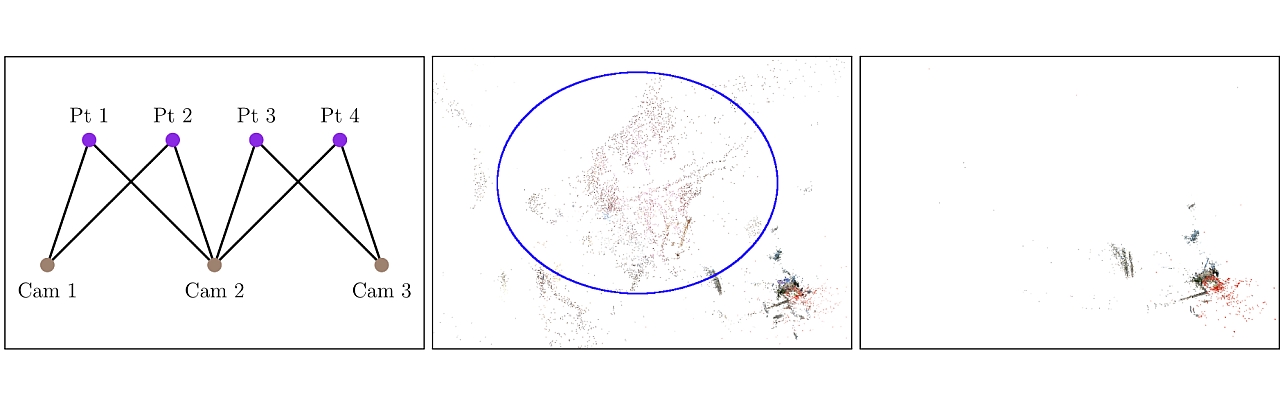
An algorithm to ensure that the topology of the bipartite graph formed by the camera-3D point relations in bundle adjustment does not result in independent scaling of the edges in its subgraphs.
MERL Researchers: Lalit Manam.
Joint work with:
Venu Madhav Govindu (Indian Institute of Science)
Bundle adjustment is a long-standing problem in computer vision that solves for camera parameters and 3D point coordinates from 2D image observations. While there has been much work on various aspects, like adaptation to different camera models and sensors, and considerations for solving the optimization problem, in this paper, we deal with a fundamental and distinct question of the uniqueness of its solution. In particular, we examine the unique solvability of the 3D reconstruction problem using parallel rigidity theory. We design an algorithm to ensure that the topology of the bipartite graph formed by the camera-3D point relations in bundle adjustment does not result in independent scaling of the edges in its subgraphs. To tackle the generally large-sized bipartite graph, we leverage camera-camera relationships in 3D reconstruction problems for efficiency. We demonstrate the benefits of our analysis for a global structure-from-motion pipeline. Applying our proposed algorithm results in significantly cleaner reconstructions by removing misplaced cameras and 3D points.
Method
Our method, GPRBA, considers the topology of the bipartite graph formed by the camera-3D point relations in bundle adjustment to infer about independent scaling through parallel rigidity theory. We use viewgraph that consists of camera-camera relationships in a viewgraph through which the bipartite graph is constructed. It can be summarized as follows.
- Identifying 4-length loops in the bipartite graph through the viewgraph.
- Extract subgraphs of the bipartite graph by combining 4-length loops through the viewgraph.
- Merge appropriate subgraphs.
This approach gives us subgraphs of the bipartite graph in bundle adjustment that do not have independent scaling issue. We also develop a filter, called HOF, to remove camera-3D point edges in the bipartite graph that are inconsistent with the viewgraph.
Results
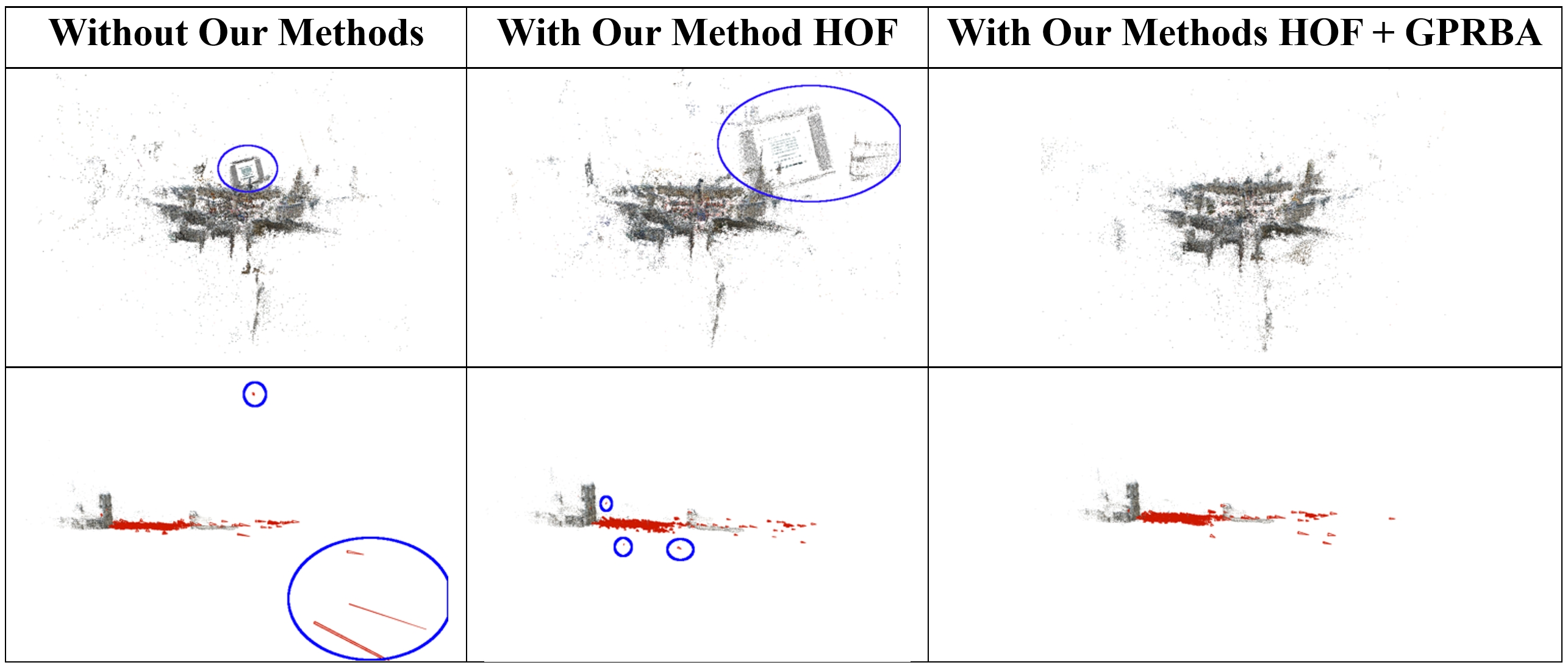
Applying HOF alone does not remove the misplaced parts in the reconstructions (blue ellipses). Applying both our methods, HOF Filter and GPRBA, results in removal of misplaced cameras and 3D points in the reconstructions.
MERL Publications
- , "Parallel Rigidity Matters for Bundle Adjustment", IEEE Conference on Computer Vision and Pattern Recognition (CVPR), May 2026, pp. 29035-29046.BibTeX TR2026-053 PDF Video Presentation
- @inproceedings{Lalit2026may,
- author = {{Manam, Lalit and Govindu, Venu}},
- title = {{Parallel Rigidity Matters for Bundle Adjustment}},
- booktitle = {IEEE/CVF Conference on Computer Vision and Pattern Recognition (CVPR)},
- year = 2026,
- pages = {29035--29046},
- month = may,
- url = {https://www.merl.com/publications/TR2026-053}
- }