TR2026-012
Embracing Cacophony: Explaining and Improving Random Mixing in Music Source Separation
-
- , "Embracing Cacophony: Explaining and Improving Random Mixing in Music Source Separation", IEEE Open Journal of Signal Processing, DOI: 10.1109/OJSP.2025.3633567, Vol. 6, pp. 1179-1192, January 2026.BibTeX TR2026-012 PDF Software
- @article{Jeon2026jan,
- author = {Jeon, Chang-Bin and Wichern, Gordon and Germain, François G and {Le Roux}, Jonathan},
- title = {{Embracing Cacophony: Explaining and Improving Random Mixing in Music Source Separation}},
- journal = {IEEE Open Journal of Signal Processing},
- year = 2026,
- volume = 6,
- pages = {1179--1192},
- month = jan,
- doi = {10.1109/OJSP.2025.3633567},
- url = {https://www.merl.com/publications/TR2026-012}
- }
- , "Embracing Cacophony: Explaining and Improving Random Mixing in Music Source Separation", IEEE Open Journal of Signal Processing, DOI: 10.1109/OJSP.2025.3633567, Vol. 6, pp. 1179-1192, January 2026.
-
MERL Contacts:
-
Research Areas:
Abstract:
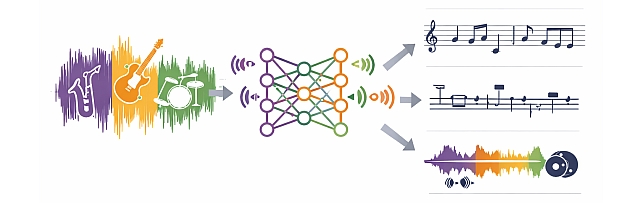
In music source separation, a standard data augmentation technique involves creating new training examples by randomly combining instrument stems from different songs. However, these randomly mixed samples lack the natural coherence of real music, as their stems do not share a consistent beat or tonality, often resulting in a cacophony. Despite this apparent distribution shift, random mixing has been widely adopted due to its effectiveness. In this work, we investigate why random mixing improves performance when training a state-of-the-art music source separation model and analyze the factors that cause performance gains to plateau despite the theoretically limitless number of possible combinations. We further explore the impact of beat and tonality mismatches on separation performance. Beyond analyzing random mixing, we introduce ways to further enhance its effectiveness. First, we explore a multi-segment sampling strategy that increases the diversity of training examples by selecting multiple segments for the target source. Second, we incorporate a digital parametric equalizer, a fundamental tool in music production, to maximize the timbral diversity of random mixes. Our experiments demonstrate that a model trained with only 100 songs from the MUSDB18-HQ dataset, combined with our proposed methods, achieves competitive performance to a BS-RNN model trained with 1,750 additional songs
Software & Data Downloads
Related News & Events
-
EVENT MERL Contributes to ICASSP 2026 Date: Monday, May 4, 2026 - , May 8, 2026
Location: Barcelona, Spain
MERL Contacts: Wael H. Ali; Petros T. Boufounos; Chiori Hori; Jonathan Le Roux; Yanting Ma; Hassan Mansour; Yoshiki Masuyama; Joshua Rapp; Anthony Vetro; Pu (Perry) Wang; Gordon Wichern
Research Areas: Artificial Intelligence, Computational Sensing, Computer Vision, Machine Learning, Optimization, Signal Processing, Speech & AudioBrief- MERL has made numerous contributions to both the organization and technical program of ICASSP 2026, which is being held in Barcelona, Spain from May 4-8, 2026.
Sponsorship
MERL is proud to be a Silver Patron of the conference and will participate in the student job fair on Thursday, May 7. Please join this session to learn more about employment opportunities at MERL, including openings for research scientists, post-docs, and interns. MERL Distinguished Research Scientists Petros T. Boufounos and Jonathan Le Roux will also present a spotlight session on MERL’s research in signal processing on Tuesday, May 5 at 13:05. Finally, MERL will sponsor a photo booth on Thursday, May 7 and Friday, May 8, where ICASSP participants can take professional photos with friends and colleagues, which will be emailed to them.
MERL is also pleased to be the sponsor of two IEEE Awards that will be presented at the conference. We congratulate Prof. Nasir Ahmed, the recipient of the 2026 IEEE Fourier Award for Signal Processing, and Dr. Alex Acero, the recipient of the 2026 IEEE James L. Flanagan Speech and Audio Processing Award.
Technical Program
MERL is presenting 8 papers in the main conference on a wide range of topics including source separation, spatial audio, neural audio codecs, radar-based pose estimation, camera-based airflow sensing, radar array processing, and optimization. Another paper on neural speech codecs will be presented at the Low-Resource Audio Codec (LRAC) Satellite Workshop. MERL researchers will also present two articles published in IEEE Open Journal of Signal Processing (OJSP) on music source separation and head-related transfer function (HRTF) modeling. Finally, Speech and Audio Team members Yoshiki Masuyama and Jonathan Le Roux co-organized a Special Session on Neural Spatial Audio Processing, which will feature six oral presentations.
About ICASSP
ICASSP is the flagship conference of the IEEE Signal Processing Society, and the world's largest and most comprehensive technical conference focused on the research advances and latest technological development in signal and information processing. The event attracts more than 4000 participants each year.
- MERL has made numerous contributions to both the organization and technical program of ICASSP 2026, which is being held in Barcelona, Spain from May 4-8, 2026.