History
The booklet below was created for MERL's 30th anniversary in 2021. It summarizes many of the research topics pursued by MERL.
MERL History
One history of MERL is organizational. In 1991, Mitsubishi Electric's Corporate Research and Development organization (CR&D) opened MERL in Cambridge, Mass., under the leadership of Dr. Tohei Nitta and Dr. Laszlo (Les) Belady. From the beginning, the focus of MERL has been on long-range research. However, MERL has evolved in various ways over the years, particularly due to the incorporation of two other labs.
Seven years before the founding of MERL, Mitsubishi Electric's Computer Business Unit founded a lab called Horizon Research Inc (HRI) in Waltham, Mass., to design mid-range computer hardware. The Computer Business Unit left that business, and HRI was transferred to CR&D in the early 1990s, where it transitioned into an advanced development software lab.
In 1993, Mitsubishi Electric's Audio/Visual Business Unit founded a lab called the Advanced TV Lab (ATL) in Murray Hill, NJ. ATL's first project was a collaboration with Bell Labs on the development of the first chipset capable of decoding US HDTV signals. When difficult economic times became prolonged in Japan, ATL too was transferred to CR&D.
In 1995, CR&D decided to combine HRI and ATL together into a new organization called Mitsubishi Electric Information Technology Center America (ITA). The next year, MERL was merged into ITA as well. An important goal of the formation of ITA was fostering collaboration between CR&D's labs in the U.S., but geography trumped good intentions and little collaboration ensued.
In 1999, Dr. Richard C. Waters became the head of MERL and proceeded to confront the root of the collaboration problems. In 2000, the staff in Waltham moved to Cambridge, and ITA returned to the name MERL. In 2003, the staff in Murray hill also moved to Cambridge. This led to a structure of two labs in Cambridge: one focused on long-range research and one on research & advanced development.
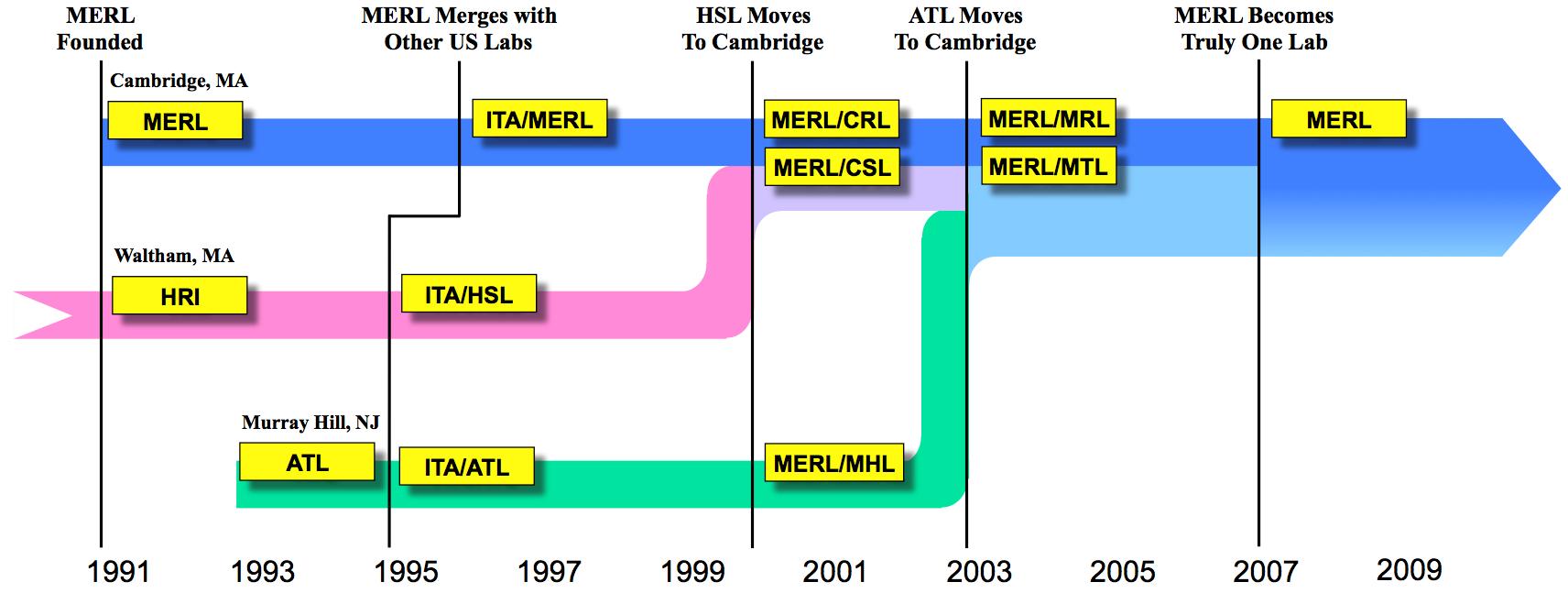
Once everyone was in the same place, strong collaboration became the norm; however, there was still a psychological division between the two labs. In 2007, MERL was reorganized into a single lab, with the unified goal of long-range research, but retaining advanced development capabilities - a structure that continues to this day.
Interaction Models
A second history of MERL is philosophical. The initial model of interaction between Mitsubishi Electric and MERL was similar to interactions with a university. MERL was to pioneer new technology in areas outside Mitsubishi Electric's current business, and it was the responsibility of Mitsubishi Electric to pick up and use the new technologies.
It should come as no real surprise that with this approach, MERL's contribution to Mitsubishi Electric's business suffered from the problems concomitant with university/industry relations in general. It is very difficult for any company to adopt new technology without a lot of support from the inventors of the technology and particularly so when the technology is outside of the company's area of business.
In the years around 2000, the interaction model changed. MERL began focusing on pioneering new technology in areas related to Mitsubishi Electric's business and increasing collaboration with our research colleagues in Japan, so that we could play an active role in transitioning our technology into business. This has proven to be a much more successful approach, leading to many significant impacts on Mitsubishi Electric's business.
Results
A third and most important history of MERL is what we have produced. We invite you to browse our 30th anniversary booklet and video below to learn about past and current research projects including areas that we have made notable impact.